

Table of Contents
What are Optical Sensors?
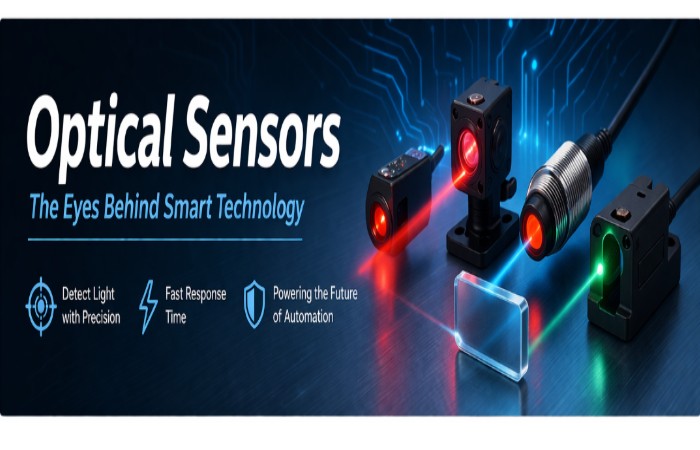
Optical sensors are devices that detect light (visible, infrared, or ultraviolet) and convert it into electrical signals for measurement, monitoring, or automation. They are widely used in industries, healthcare, consumer electronics, and smart systems.
How Optical Sensors Work
Optical sensors operate based on the principle of light transmission, reflection, or interruption.
Working Steps:
A light source emits light
- The light interacts with an object
- The sensor detects changes in light intensity
- The detector converts light into an electrical signal
- The system processes the signal for output
Types of Optical Sensors
| Type | Description | Example Use |
| Photoelectric Sensors | Detect objects using light beams | Industrial automation |
| Fiber Optic Sensors | Use optical fibers for sensing | Medical devices |
| Infrared Sensors | Detect heat/light in IR range | Motion detection |
| Ultraviolet Sensors | Detect UV radiation | Environmental monitoring |
| Laser Sensors | High precision detection | Distance measurement |
| Ambient Light Sensors | Measure light levels | Smartphones |
| Color Sensors | Detect color variations | Quality control |
| Optical Encoders | Measure motion/position | Robotics |
Components of Optical Sensors
| Component | Function |
| Light Source | Emits light (LED/Laser) |
| Optical Fiber | Transmits light |
| Photodetector | Detects light |
| Signal Processor | Converts signal |
| Lens | Focuses light |
| Housing | Protects components |
| Amplifier | Enhances signal |
| Output Interface | Sends data |
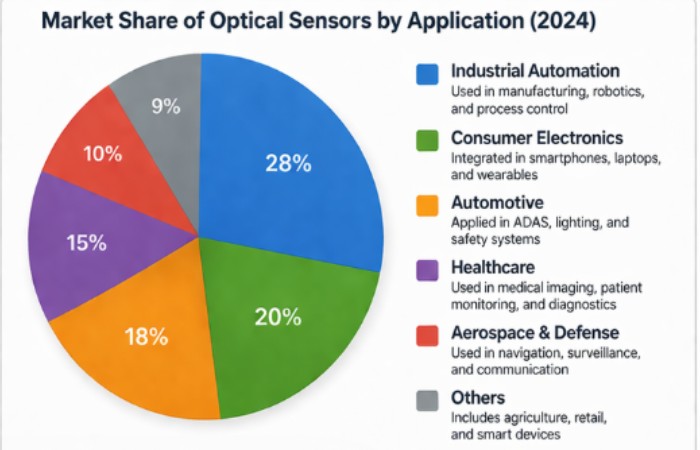
Applications of Optical Sensors
| Industry | Application | Example |
| Industrial | Object detection | Assembly lines |
| Healthcare | Monitoring | Pulse oximeters |
| Automotive | Safety systems | Parking sensors |
| Electronics | Display control | Auto brightness |
| Agriculture | Crop monitoring | Soil analysis |
| Security | Surveillance | Motion sensors |
| Aerospace | Navigation | Position sensing |
| Retail | Automation | Barcode scanners |
Advantages of Optical Sensors
| Advantage | Explanation |
| High Accuracy | Precise measurements |
| Fast Response | Instant detection |
| Non-contact | No physical interaction |
| Versatility | Multiple applications |
| Compact Size | Small devices |
| Energy Efficient | Low power usage |
| Reliable | Consistent performance |
| Safe | No electrical interference |
Disadvantages of Optical Sensors
| Disadvantage | Explanation |
| Sensitive to Environment | Dust, light interference |
| Cost | Can be expensive |
| Alignment Issues | Requires proper setup |
| Limited Range | Depends on type |
| Maintenance | Needs cleaning |
| Signal Distortion | External interference |
| Complexity | Advanced systems |
| Calibration Needed | Regular adjustments |
Optical Sensors vs Other Sensor Types
| Feature | Optical Sensors | Mechanical Sensors | Electrical Sensors |
| Contact | Non-contact | Contact-based | Contact/non-contact |
| Accuracy | High | Medium | Medium |
| Speed | Fast | Slow | Moderate |
| Durability | High | Lower | Moderate |
| Cost | Moderate-High | Low | Moderate |
| Maintenance | Low | High | Medium |
| Applications | Wide | Limited | Wide |
| Interference | Light-based | Physical | Electrical noise |
Industrial Uses of Optical Sensors
- Object detection in production lines
- Quality control systems
- Robotics and automation
- Packaging systems
- Conveyor belt monitoring
- Barcode scanning
- Safety systems
- Position sensing
Optical Sensors in Healthcare
| Application | Description |
| Pulse Oximeters | Measure oxygen levels |
| Imaging Systems | Medical diagnostics |
| Biosensors | Detect biological signals |
| Wearables | Health tracking |
| Laser Surgery | Precision operations |
| Monitoring Devices | Patient tracking |
| Lab Equipment | Sample analysis |
| Smart Devices | Health apps |
Optical Sensors in Consumer Electronics
| Device | Usage |
| Smartphones | Auto brightness |
| TVs | Light adjustment |
| Cameras | Image detection |
| Tablets | Display control |
| Smartwatches | Health monitoring |
| Laptops | Screen brightness |
| Gaming Devices | Motion sensing |
| Smart Lights | Ambient sensing |
Optical Sensors in Automation and Robotics
| Function | Example |
| Object Detection | Robotic arms |
| Position Tracking | CNC machines |
| Navigation | Autonomous robots |
| Safety Monitoring | Collision avoidance |
| Sorting | Automated systems |
| Quality Inspection | Vision systems |
| Motion Detection | Smart robots |
| Feedback Systems | Control loops |
Optical Sensors in Automotive Industry
| Application | Example |
| Parking Sensors | Obstacle detection |
| Lane Detection | Driver assistance |
| Rain Sensors | Automatic wipers |
| Light Sensors | Auto headlights |
| Safety Systems | Collision avoidance |
| Navigation | GPS integration |
| Speed Detection | Monitoring |
| Autonomous Driving | AI systems |
Optical Sensors in Smart Devices
| Device | Function |
| Smart Homes | Light control |
| IoT Devices | Data sensing |
| Wearables | Health tracking |
| Security Systems | Motion detection |
| Smart Assistants | Environment sensing |
| Smart Appliances | Automation |
| Lighting Systems | Brightness control |
| Smart Cities | Traffic monitoring |
Key Technologies Used in Optical Sensors
| Technology | Description |
| Laser Technology | High precision sensing |
| Fiber Optics | Signal transmission |
| Photodiodes | Light detection |
| CMOS Sensors | Imaging |
| CCD Sensors | High-quality imaging |
| Infrared Tech | Heat detection |
| AI Integration | Smart sensing |
| IoT Integration | Connectivity |
Factors to Consider When Choosing Optical Sensors
| Factor | Importance |
| Range | Detection distance |
| Accuracy | Measurement precision |
| Environment | Dust/light conditions |
| Cost | Budget |
| Response Time | Speed |
| Size | Installation space |
| Power Consumption | Efficiency |
| Compatibility | System integration |
Optical Sensor Working Principle Explained
Optical sensors work based on three main principles:
- Through-beam: Light passes directly to receiver
- Reflective: Light reflects off object
- Diffuse: Light scatters and is detected
These principles help in detecting presence, distance, and movement.
Latest Trends in Optical Sensor Technology
| Trend | Description |
| AI Integration | Smart sensing systems |
| Miniaturization | Smaller devices |
| IoT Connectivity | Real-time data |
| High-Speed Sensors | Faster detection |
| 3D Sensing | Advanced imaging |
| Wearable Sensors | Health tracking |
| Smart Automation | Industry 4.0 |
| Energy Efficiency | Low power usage |
Optical Sensor Manufacturers and Brands
| Brand | Specialization |
| Siemens | Industrial automation |
| Omron | Sensors & automation |
| Honeywell | Industrial solutions |
| Panasonic | Electronics |
| Keyence | High-end sensors |
| Bosch | Automotive sensors |
| Rockwell Automation | Industrial systems |
| STMicroelectronics | Semiconductor sensors |
Future of Optical Sensors
The future of optical sensors is driven by AI, IoT, and smart technologies.
Key developments include:
- Advanced autonomous systems
- Growth in wearable health devices
- Expansion in smart cities
- Integration with AI and machine learning
- Increased use in automation and robotics
Optical sensors will become more:
- Intelligent
- Compact
- Energy-efficient
- Widely integrated
Conclusion
Optical sensors play a crucial role in modern technology by enabling precise, fast, and non-contact detection across various industries. From healthcare and automation to consumer electronics and smart devices, their applications are continuously expanding. With advancements in AI, IoT, and miniaturization, optical sensors are becoming more powerful and efficient, shaping the future of intelligent systems and automation worldwide.
FAQs
1. What are optical sensors used for?
Optical sensors are used to detect light and convert it into electrical signals for applications like automation, healthcare, and electronics.
2. What are the main types of optical sensors?
The main types include photoelectric sensors, fiber optic sensors, infrared sensors, laser sensors, and ambient light sensors.
3. How do optical sensors work?
They work by emitting light, detecting changes in light intensity, and converting it into electrical signals for processing.
4. What are the advantages of optical sensors?
They offer high accuracy, fast response, non-contact detection, and versatility across industries.
5. Where are optical sensors commonly used?
They are used in industries, healthcare devices, smartphones, automotive systems, and smart technologies.
6. Are optical sensors expensive?
Costs vary depending on type and application, but advanced sensors can be relatively expensive.
7. What is the difference between optical and infrared sensors?
Infrared sensors are a type of optical sensor that specifically detect infrared light or heat.
8. What is the future of optical sensors?
The future includes AI integration, IoT connectivity, miniaturization, and increased use in automation and smart systems.