

Programming languages are formal languages consisting of a set of instructions used to create software, websites, and systems. They act as a bridge between human logic and machine execution, as computers fundamentally understand only binary code (1s and 0s).
Table of Contents
Overview of Programming Languages
Programming languages enable developers to design applications, automate tasks, and control hardware. They translate human-readable logic into machine-executable instructions.
Key Functions:
- Software development
- Web & mobile app creation
- Data analysis & AI
- System programming
- Automation & scripting
Modern development often involves multiple programming languages within a single project.
Types of Programming Languages
| Type | Description | Examples | Where Used | When to Use |
| Machine Language | Binary instructions executed by CPU | 0s & 1s | Embedded systems | Hardware-level control |
| Assembly Language | Symbolic representation of machine code | x86 Assembly | Device drivers | Performance-critical tasks |
| Procedural | Step-by-step instructions | C, Pascal | System software | Structured programs |
| Object-Oriented | Based on objects & classes | Java, C++ | Enterprise apps | Large scalable systems |
| Functional | Uses mathematical functions | Haskell, Lisp | AI & research | Complex logic |
| Scripting | Automates tasks | Python, JavaScript | Web & automation | Rapid development |
| Logic Programming | Rule-based logic | Prolog | AI systems | Knowledge-based systems |
High-Level vs Low-Level Languages
| Feature | Low-Level Languages | High-Level Languages |
| Human readability | Very low | High |
| Speed | Very fast | Moderate |
| Hardware control | Direct | Limited |
| Ease of learning | Difficult | Easy |
| Examples | Assembly, Machine | Python, Java |
Most Popular Programming Languages (2025–2026)
| Rank | Language | Approx. Popularity | Key Uses |
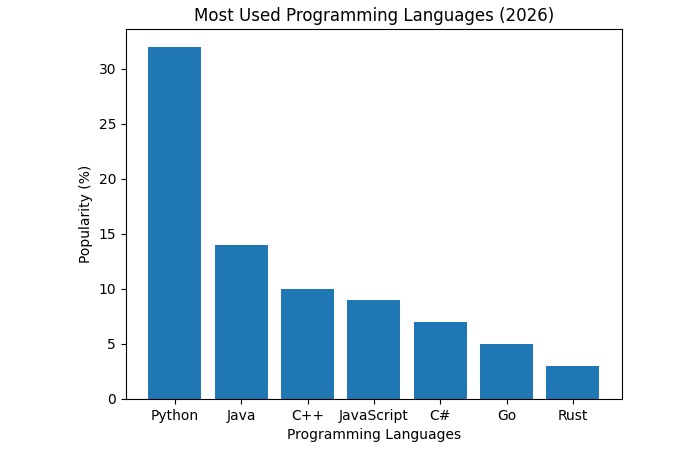
| 1 | Python | ~26–32% | AI, data science, web |
| 2 | C++ | ~11% | Game engines, performance apps |
| 3 | Java | ~10–14% | Enterprise & Android |
| 4 | C | ~9–10% | OS & embedded systems |
| 5 | JavaScript | Widely used | Web development |
| 6 | C# | ~4% | .NET apps, games |
| 7 | Go | Growing | Cloud computing |
| 8 | Rust | Rising | Secure systems |
Most Used Programming Languages Worldwide (2025–2026)
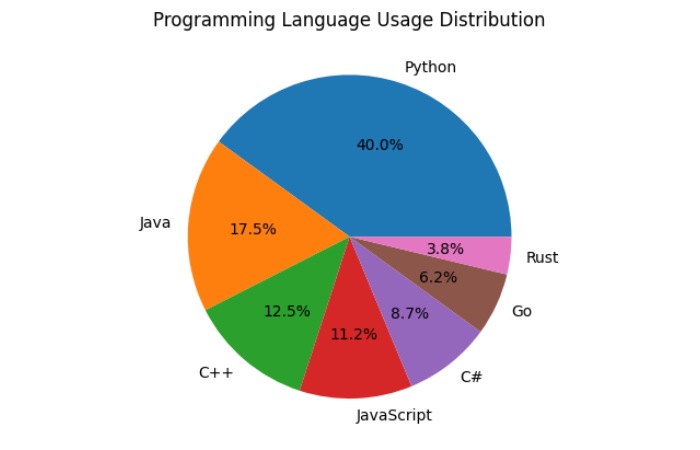
Global Programming Language Usage Distribution
Where Programming Languages Are Used
| Industry | Languages Used | Purpose |
| Web Development | JavaScript, PHP, Python | Websites & APIs |
| Mobile Apps | Java, Kotlin, Swift | Android & iOS |
| AI & Data Science | Python, R | Machine learning |
| Game Development | C++, C# | Game engines |
| Embedded Systems | C, Assembly | IoT & hardware |
| Cloud Computing | Go, Python | Scalable services |
When to Use Which Programming Language
| Scenario | Recommended Language | Reason |
| Beginner learning | Python | Easy syntax |
| High performance | C++ | Speed & memory control |
| Enterprise apps | Java | Scalability |
| Web apps | JavaScript | Browser support |
| AI projects | Python | Rich libraries |
| Secure systems | Rust | Memory safety |
How to Use Programming Languages
Step-by-Step Process:
- Install language compiler/interpreter
- Write code using IDE (VS Code, IntelliJ)
- Compile or run code
- Debug errors
- Deploy application
Installation & Setup
| Scenario | Recommended Language | Reason |
| Beginner learning | Python | Easy syntax |
| High performance | C++ | Speed & memory control |
| Enterprise apps | Java | Scalability |
| Web apps | JavaScript | Browser support |
| AI projects | Python | Rich libraries |
| Secure systems | Rust | Memory safety |
Services & Platforms Supporting Programming
| Service | Purpose | Popular Tools |
| Version Control | Code management | Git, GitHub |
| Cloud IDEs | Online coding | Replit, Gitpod |
| Hosting | Deploy apps | AWS, Azure |
| CI/CD | Automation | Jenkins, GitHub Actions |
Programming Language Courses & Learning Platforms
| Platform | Courses Offered | Suitable For |
| Coursera | Python, Java | Beginners–Advanced |
| Udemy | Web & AI | Practical skills |
| edX | CS fundamentals | Academic learning |
| freeCodeCamp | Full-stack | Self-paced |
Advantages & Disadvantages
| Aspect | Advantages | Disadvantages |
| Automation | Saves time | Requires skills |
| Scalability | Handles large systems | Complex design |
| Innovation | Enables AI & tech | Rapid obsolescence |
| Efficiency | Improves productivity | Debugging challenges |
History of Programming Languages
Key Milestones
- 1950s: FORTRAN, COBOL
- 1970s: C language
- 1990s: Java & JavaScript
- 2000s: Python rise
- 2020s: AI-driven languages growth
Programming languages evolved alongside computing needs.
Real-World Use Cases
| Application | Language | Example |
| Python | Backend systems | |
| Android Apps | Java/Kotlin | Mobile apps |
| Web Apps | JavaScript | Interactive UI |
| AI Models | Python | Machine learning |
Python’s versatility contributes to its dominance in AI and automation.
Future Trends in Programming Languages
- Emerging Trends
- AI-assisted coding
- Memory-safe languages
- Cloud-native development
- Low-code & no-code platforms
Python remains dominant due to versatility and ecosystem strength.
Conclusion
Programming languages are the foundation of the digital world, enabling everything from mobile apps to artificial intelligence. With evolving technologies, developers increasingly use multiple languages to build efficient, scalable, and secure systems.