

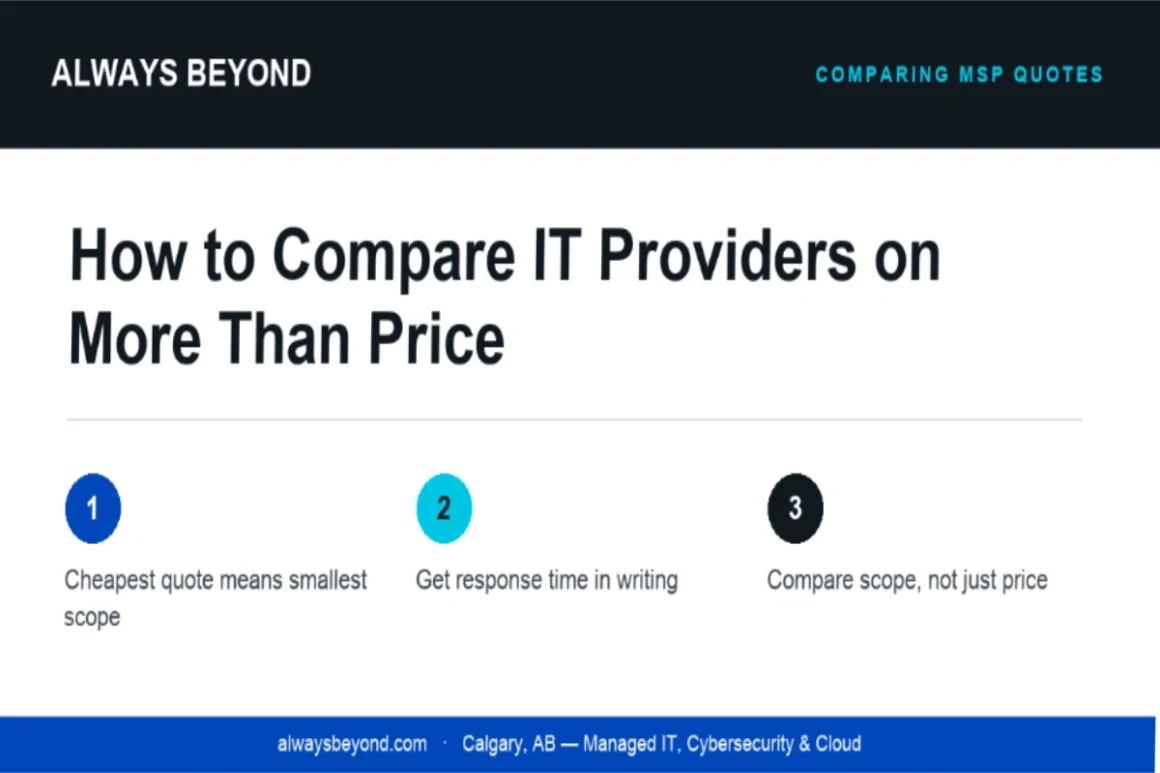
Somewhere right now, a business owner is looking at three IT proposals spread across a desk, and the cheapest one is winning by default. I get the instinct. Nobody wants to overpay for something as unglamorous as network monitoring and patching. But I’ve watched this exact decision get made, and unmade six months later at twice the cost and a lot more stress, enough times to have opinions about it. The lowest number on the page is almost never the lowest cost of the engagement. It’s just the smallest scope, dressed up to look like a bargain.
Price is the easiest thing to compare and the least useful. That’s precisely why so many proposals lead with it. What actually separates a serious managed IT service provider from a cut-rate one rarely shows up on the first page: it’s buried in what’s included, what’s excluded, and what counts as an “extra” the moment something goes wrong. A quote that looks noticeably cheaper is usually a quote that’s noticeably smaller, not a quote that found a more efficient way to do the same work. Nobody discovered a secret way to deliver the same coverage for less. They just quietly took things off the list.
So what should a serious proposal actually contain? Start with scope, stated in plain language rather than vague reassurance. Does it cover every device and every user, or just servers? Does cybersecurity monitoring come standard, or is it a line item you’ll be upsold on in month four? Is cloud environment management, whether that’s Microsoft 365 or Google Workspace, actually included, or does “IT support” quietly stop the moment the problem lives in the cloud instead of on a local machine? Vague answers to any of these questions are answers.
Response time deserves the same scrutiny, and it’s where a lot of proposals get slippery. “Fast response” means nothing. A stated number, in writing, means something. Ask what happens when you call: how long before a human picks up, and what happens next. A provider that can tell you their actual average phone response time, rather than a marketing range with an “up to” in front of it, is a provider that measures itself and has nothing to hide. That specificity is worth more than almost anything else on the page.
The same logic applies to how a provider talks about its own performance. Anyone can say clients are happy. Fewer providers actually track it and put a real figure behind the claim. If a company can tell you, without flinching, what share of client requests get rated positively, you’re looking at a provider that treats service quality as data rather than as a slogan.
Then there’s the question nobody likes asking out loud: what happens if it goes wrong anyway. A serious provider will tell you plainly what they guarantee and what they don’t, rather than leaning on vague promises about being “proactive.” Look for language about accountability, not just capability. Anyone can claim they’ll keep you secure. Fewer providers are willing to put something resembling a guarantee behind that claim.
Contract terms matter more than people expect walking in. A long-term lock-in with no exit isn’t a sign of confidence, it’s a sign the provider is betting you won’t leave even if the service disappoints. One clean package with no tiers and no hidden fees, month to month, tells you something different: the provider believes the work itself is the reason you’ll stay, not the paperwork. That’s a meaningfully different bet to be making on your behalf.
None of this means the most expensive proposal is automatically the best one, either. Some providers pad their pricing with things a smaller business genuinely doesn’t need. The point isn’t to chase the highest number any more than the lowest. It’s to make every proposal answer the same specific questions, side by side, so you’re comparing actual scope instead of comparing marketing copy. Ask each vendor to define their scope, their response time, their security commitments, and their contract terms in writing, then hold the cheap one to the same standard as the expensive one.
The businesses that get burned aren’t the ones who paid too much. They’re the ones who never found out what they weren’t paying for until the invoice for the “extra” work showed up. Read the proposal like you’re looking for what’s missing, not just what’s promised. It is because that’s usually where the real price of the contract is hiding.