


Table of Contents
What is Tax Compliance?
Tax compliance refers to the process of adhering to all tax laws, regulations, and requirements set by government authorities. It includes accurately reporting income, filing tax returns on time, and paying the correct amount of taxes.
It applies to:
- Individuals
- Small businesses
- Corporations
- Multinational companies
Importance of Tax Compliance for Individuals and Businesses
| Aspect | Individuals | Businesses |
| Legal Obligation | Avoids legal trouble and audits | Prevents lawsuits and government penalties |
| Financial Stability | Prevents fines and extra charges | Ensures smooth cash flow and planning |
| Reputation | Builds financial credibility | Enhances brand trust and investor confidence |
| Access to Services | Needed for loans, visas, credit | Required for funding, partnerships |
| Government Contribution | Supports public services | Contributes to economic development |
| Audit Risk | Reduces scrutiny | Minimizes risk of investigations |
| Peace of Mind | Stress-free financial management | Smooth business operations |
| Long-Term Benefits | Easier wealth management | Sustainable growth and expansion |
Types of Taxes Covered Under Tax Compliance
| Tax Type | Description | Applicable To | Example |
| Income Tax | Tax on earnings | Individuals & Businesses | Salary tax |
| Corporate Tax | Tax on company profits | Corporations | Company earnings |
| Goods & Services Tax (GST) | Indirect tax on goods/services | Businesses | Sales tax |
| Value Added Tax (VAT) | Consumption tax | Businesses | EU countries |
| Payroll Tax | Tax on employee wages | Employers | TDS, Social Security |
| Capital Gains Tax | Tax on asset profit | Investors | Property sale |
| Property Tax | Tax on owned property | Individuals & Businesses | Real estate |
| Customs Duty | Tax on imports/exports | Businesses | Imported goods |
| Excise Duty | Tax on specific goods | Manufacturers | Alcohol, fuel |
| Withholding Tax | Tax deducted at source | Individuals & Businesses | TDS in India |
Tax Compliance Process Explained

- Register with Tax Authorities
- Maintain Accurate Financial Records
- Identify Applicable Taxes
- Calculate Tax Liability
- File Tax Returns on Time
- Pay Taxes Due
- Respond to Notices or Audits
- Keep Documentation for Future Reference
Tax Compliance Requirements Country-wise
| Country | Key Tax Authority | Main Taxes | Filing Frequency | Special Notes |
| India | Income Tax Department | Income Tax, GST | Annual/Quarterly | GST compliance mandatory |
| USA | IRS | Federal, State Taxes | Annual | Complex multi-layer system |
| UK | HMRC | Income Tax, VAT | Annual/Quarterly | Digital tax system (MTD) |
| UAE | Federal Tax Authority | VAT, Corporate Tax | Quarterly | No personal income tax |
| Australia | ATO | Income Tax, GST | Annual | Strict reporting rules |
| Canada | CRA | Federal & Provincial Taxes | Annual | Combined tax structure |
| Germany | Federal Central Tax Office | VAT, Income Tax | Monthly/Annual | High compliance standards |
| Singapore | IRAS | Corporate & Personal Tax | Annual | Business-friendly tax system |
Common Tax Compliance Challenges
- Complex tax laws and frequent updates
- Lack of proper record-keeping
- Misinterpretation of tax rules
- Late filing or payment delays
- Handling multi-country taxation
- Managing GST/VAT compliance
- Audit risks and scrutiny
- Technology and system limitations
Tax Compliance for Small Businesses and Corporations
| Aspect | Small Businesses | Corporations |
| Complexity | Low to Medium | High |
| Tax Types | Income Tax, GST | Corporate, International Taxes |
| Filing Requirements | Simple returns | Multiple filings |
| Resources | Limited staff | Dedicated tax teams |
| Compliance Cost | Lower | Higher |
| Risk Level | Moderate | High |
| Automation | Limited tools | Advanced software |
| Regulations | Local | Global compliance |
Role of Technology, Software and Tools in Tax Compliance
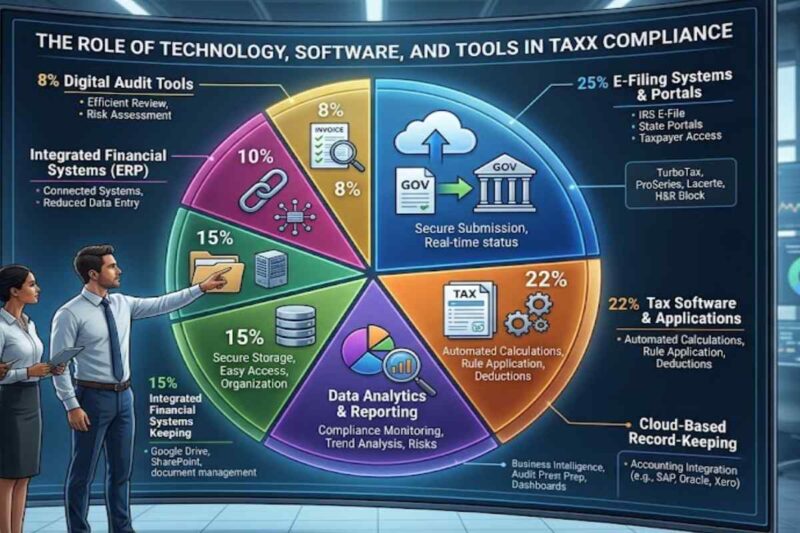
| Category | Function | Examples | Benefits |
| Accounting Software | Manage finances | QuickBooks, Tally | Accurate records |
| Tax Filing Software | Automates filing | TurboTax | Saves time |
| ERP Systems | Integrated management | SAP, Oracle | Centralized data |
| AI Tools | Predict errors | AI tax assistants | Reduces mistakes |
| Cloud Platforms | Data storage | Xero | Accessibility |
| Compliance Tools | Regulatory tracking | Avalara | Real-time updates |
| Audit Tools | Risk detection | Thomson Reuters | Better audit readiness |
| Data Analytics | Insights | Power BI | Better decision-making |
Penalties for Non-Compliance
- Financial penalties and fines
- Interest on unpaid taxes
- Legal actions and prosecution
- Business license cancellation
- Asset seizure
- Audit investigations
- Reputation damage
- Restrictions on future operations
How to Ensure Proper Tax Compliance (Step-by-Step)
- Understand applicable tax laws
- Register with relevant authorities
- Maintain proper accounting records
- Use reliable accounting software
- Track deadlines for filing and payments
- Hire a tax professional if needed
- Conduct regular internal audits
- Stay updated with tax law changes
- File returns accurately and on time
- Keep records for audits
Benefits of Staying Tax Compliant
- Avoids penalties and legal issues
- Builds credibility and trust
- Ensures smooth business operations
- Improves financial planning
- Easier access to loans and funding
- Reduces audit risks
- Supports business growth
- Enhances peace of mind
Tax Compliance vs Tax Planning
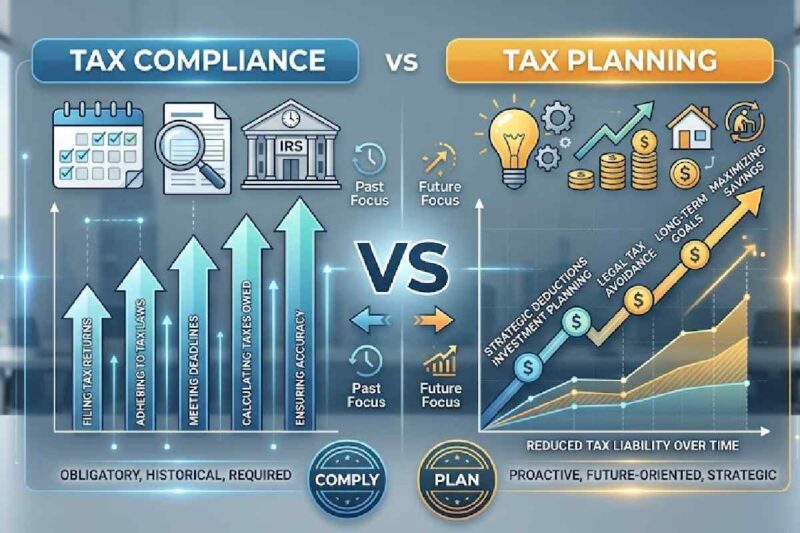
| Aspect | Tax Compliance | Tax Planning |
| Definition | Following tax laws | Minimizing tax liability legally |
| Objective | Avoid penalties | Save money |
| Nature | Mandatory | Strategic |
| Approach | Reactive | Proactive |
| Risk Level | Low | Moderate |
| Focus | Accuracy | Optimization |
| Timing | After income earned | Before financial decisions |
| Outcome | Legal adherence | Tax efficiency |
Latest Updates in Tax Compliance 2026
| Update | Description | Impact |
| Digital Tax Systems | Increased e-filing globally | Faster compliance |
| AI Integration | Automated tax calculations | Reduced errors |
| Global Minimum Tax | OECD framework adoption | Affects MNCs |
| Real-Time Reporting | Instant tax tracking | Transparency |
| GST Reforms | Simplified filing | Business ease |
| E-Invoicing Expansion | Mandatory digital invoices | Better tracking |
| Data Sharing | Cross-border info exchange | Reduced tax evasion |
| ESG Tax Reporting | Sustainability-linked taxes | Corporate accountability |
Government and International Regulations and Tax Authorities
| Region | Authority | Role | Key Regulations |
| India | Income Tax Dept | Tax collection | Income Tax Act |
| USA | IRS | Federal taxes | Internal Revenue Code |
| UK | HMRC | Tax admin | Finance Act |
| Global | OECD | Policy framework | BEPS |
| EU | European Commission | VAT rules | EU VAT Directive |
| UAE | FTA | Tax regulation | VAT Law |
| Australia | ATO | Tax enforcement | Taxation Laws |
| Canada | CRA | Tax collection | Income Tax Act |
Future of Tax Compliance
Tax compliance is rapidly evolving with technology and globalization:
- Increased use of AI and automation
- Growth of real-time tax reporting systems
- Expansion of global tax regulations
- Stronger focus on data transparency
- Integration with blockchain technology
- Simplification through digital platforms.
In the future, tax compliance will become:
- More automated
- More transparent
- More globally standardized
Conclusion
Tax compliance is a fundamental responsibility for both individuals and businesses, ensuring adherence to legal requirements while contributing to economic stability. With evolving regulations, digital transformation, and global tax frameworks, staying compliant is no longer just about filing returns—it requires accurate record-keeping, timely reporting, and strategic use of technology. By understanding tax obligations, leveraging modern tools, and maintaining a proactive approach, taxpayers can avoid penalties, build credibility, and achieve long-term financial success.
FAQs
1. What happens if I fail to comply with tax regulations?
Failure to comply can result in penalties, interest charges, audits, legal action, and even business closure in severe cases.
2. Who needs to follow tax compliance rules?
Everyone earning income—including individuals, freelancers, small businesses, and large corporations—must comply with applicable tax laws.
3. How can I simplify tax compliance?
You can simplify compliance by using accounting software, maintaining proper records, hiring a tax professional, and staying updated with tax laws.
4. Is tax compliance the same in every country?
No, tax compliance varies by country, as each government has its own tax laws, filing systems, and regulations.
5. Can technology help in tax compliance?
Yes, modern tools like tax software, AI-based systems, and cloud platforms make tax filing more accurate, faster, and easier to manage.